In our practice, we see too many avoidable and tragic trucking accidents involving serious injury and many times fatalities. Sharing the road with large trucks and commercial vehicles is unavoidable. Florida has over 275,000 miles of road and they have become a dangerous place. Trucks with heavy loads and distracted drivers are weapons loaded and aimed at each of us on the highway.
According to the National Highway Traffic Safety Administration (NHTSA), in 2020:
- The number of large trucks involved in fatal crashes was 4,965
- The number of large trucks involved in injury crashes was 146,930
What is a commercial motor vehicle?
A commercial motor vehicle is used in commerce to transport property or passengers and has specific weight criteria or was designed to transport a specific number of passengers or hazardous loads. More often than not, these look like semi-trucks, 18-wheelers, or passenger buses. The rules and regulations for these vehicles are must stricter than those for cars and pickup trucks. By definition, a commercial motor vehicle is used in interstate transportation and:
- A gross combination weight rating or gross combination weight of 26,001 pounds or more, including the towed unit with a gross vehicle weight rating or gross vehicle weight of more than 10,000 pounds, whichever is greater
- A gross vehicle weight rating or gross vehicle weight of 26,001 pounds or more, whichever is greater
- A design to transport 16 or more passengers (including the driver)
- A vehicle, of any size, used to transport materials that are found to be hazardous
A commercial motor vehicle is regulated by the Federal Motor Carrier Safety Administration with standards that require safe operation, training, and inspections in order to prevent disaster. Businesses that place commercial motor vehicles on the road have a duty to other drivers to ensure their trucks and truck drivers are operating in a reasonably prudent manner. Tragically, when a trucking company does not comply with the Federal Motor Carrier Safety Regulations, innocent people on the road become victims.
Common trucking accidents:
Trucking accidents are common in Florida with our expansive highway systems and large population. Some of the most common types of truck crashes include:
- Distracted truck drivers
- Improperly secured load
- Brake failure
- Overloaded trailers
- Tire blowout
- Maintenance failure
- Equipment failure
- Truck drivers that do not qualify to drive.
Understanding the common dangers of being on the road with trucks allows you to stay vigilant. However, trucking companies also need to do their part. Truck crashes result in fatalities and serious injuries because the size and force of a truck are much greater than that of a passenger vehicle on the road. The weight of a truck and loaded trailer, in combination with the speed it is traveling when moving down the highway, explain why crashes involving trucks often turn deadly. It is also easy to understand why the Federal government has created regulations that the trucking companies must follow – because rules keep drivers safe. Trucking companies must do their part to ensure that their drivers are trained and that their trucks are maintained and safe to be on the road.
How to drive safely while on the road with trucks:
There are ways you can drive which will keep you safer on the road with trucks. Remain alert and vigilant at all times. And follow these tips, courtesy of https://www.flhsmv.gov/safety-center/driving-safety/share-the-road/
- Motorists are encouraged to stay out of the “No Zone” areas. Commercial motor vehicles have large blind spots in front, behind, and on both sides of the vehicle; this is known as the “No Zone.” Even though large vehicles have several rear-view mirrors, other vehicles will be hidden from view if within the “No Zone” or blind spot.
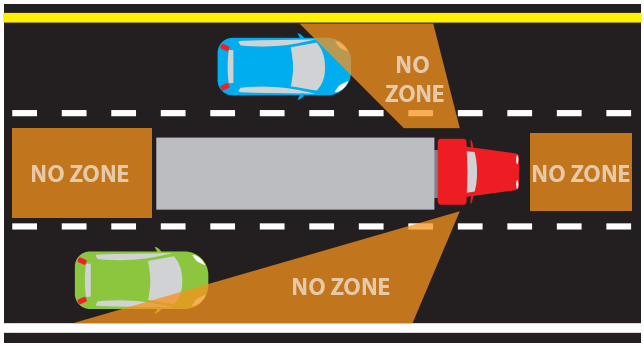
- Do not tailgate; you’ll be in the rear blind spot and may collide with the truck if it stops unexpectedly.
- If you are stopped behind a truck on an upgrade, leave space in case the truck drifts back when it starts to move. Also, keep to the left in your lane so the driver can see that you’re stopped behind the truck.
- Do not use high beam headlights when you are following a truck at night. Bright lights will blind the driver when they reflect off the truck’s large side mirrors.
- When you meet a truck coming from the opposite direction, keep to the right to avoid a sideswipe crash.
- Commercial motor vehicles often need to swing wide to the left in order make a right turn. Do not drive between the commercial vehicle and the curb—they will not be able to see you.
- Never cross behind a truck that is preparing to back up or is in the process of doing so. Remember, the size of most trucks and trailers completely hide objects behind them from view.
- Pass trucks on the left side for maximum visibility. Avoid cutting in too soon when passing a truck. Large vehicles cannot stop as quickly as other vehicles. Never linger besides a large truck or bus.
- When a truck passes you, keep to the right side of your lane. Do not speed up while the truck is passing you.
What to do immediately if you are involved in a trucking accident:
After a trucking accident, it is critical that you reach out to an attorney immediately to preserve evidence in your case. Your attorney will do what is necessary to investigate the scene, preserve evidence and collect data from the truck’s black box. A black box or data event recorder is located inside the truck and it stores and retains information from the moments before the crash. We can use that information to learn what the truck and the truck driver did or didn’t do in the moments leading up to the crash.
As technology grows, the amount of information available in a truck’s data event recorder is expanding and sheds light on what happened and why it happened. Experts can determine which sensors were triggered, if the brakes were applied, and how fast the truck was going at the time of impact. Engineers can even use this data to build an accident reconstruction video or diagram and determine what happened. Evidence is likely to be destroyed or mishandled if there is any delay in hiring an attorney that specializes in trucking cases.
Romano Law Group has a team of attorneys who are experienced in handling complex trucking cases. Our attorneys do a full investigation into the cause of the crash, go to the scene to collect physical evidence, collect photos or videos, and most importantly, inspect the truck and vehicles involved with an engineering expert, who can download the black box from the truck.
The post Trucking Accidents: How to stay safe and avoid tragedy appeared first on Romano Law Group.